Movement in digital art can reveal the operation of a system. A curve that changes slowly shows a relationship between parameters; a group of forms that move at different rates may make their structure apparent in a way a still image cannot. Animation becomes less useful when almost everything in a composition moves independently and little remains stable enough for the viewer to follow. A good motion study starts by identifying what the movement should communicate. The drawing rule then determines what changes, which properties remain constant and how time connects successive states.
Choose a change the viewer can recognize
Suppose a sketch consists of a field of parallel lines that bend around an opening. Animate the position of the opening while preserving the basic distribution of lines, their color roles and the dimensions of the field. As the opening travels, the curves respond together and the relationship is visible. An alternative is to hold the opening in place and vary the amount of bending, allowing the viewer to see the transition from order to distortion. These are two distinct studies. Combining both changes immediately may produce more elaborate motion while making it harder to understand either one.
A stable feature can act as a reference against which change is perceived. In a circular arrangement, the background center or outer boundary might remain fixed while interior shapes rotate. In a line study, constant interval marks at the edge may establish the motion of the curves in between. Look at a short sequence of still frames. If every element has shifted, changed size and changed color between adjacent frames, the viewer may struggle to relate them to one another. Simplifying what changes is often the quickest improvement to an unreadable animation.
Separate the drawing rule from time
A useful way to structure a motion sketch is to make a drawing function that accepts an explicit state, such as an amplitude, angle or normalized progress value. Time is responsible for calculating that state, while the drawing function is responsible for producing the geometry. That separation permits a selected frame to be drawn without playing the whole animation. It also makes it easier to create a static alternative or experiment with a different pace without rewriting the underlying composition. The sketch can be inspected with known values rather than relying entirely on the live playback state.
For a repeating movement, an angle derived from elapsed time can drive a sinusoidal value. One complete cycle returns the parameter to its original value and makes it possible to create a continuous loop. Check whether every dependent property also returns to its initial state. If an independent random choice occurs on every frame, the geometry may jump abruptly even when the main parameter is periodic. Generate stable random relationships outside the time-dependent calculation unless the change in randomness is itself an important part of the piece.
Related reading: Generative lines as a visual language.
Use elapsed time rather than counting frames as the only measure of progress when movement is meant to maintain a consistent pace. Playback rates can vary between devices and depending on the complexity of the sketch. If a model simply advances by a fixed amount for each displayed frame, slower rendering may also slow the movement. Computing state from elapsed time produces a more consistent cycle, although individual frames may still be missed on busy devices. Reduce the rendering cost if lost detail makes the motion difficult to perceive.
Pacing influences the character of motion
A steady speed suits some visual experiments, particularly those intended to communicate a constant rotation or translation. Other motion becomes easier to read when it slows near significant positions and accelerates between them. Smooth transitions can make a change feel continuous rather than like a jump between unrelated layouts. Experiment with a small number of pacing rules before layering additional movement. Hold an important state briefly if that state deserves inspection; a pause may communicate more than another decorative effect.
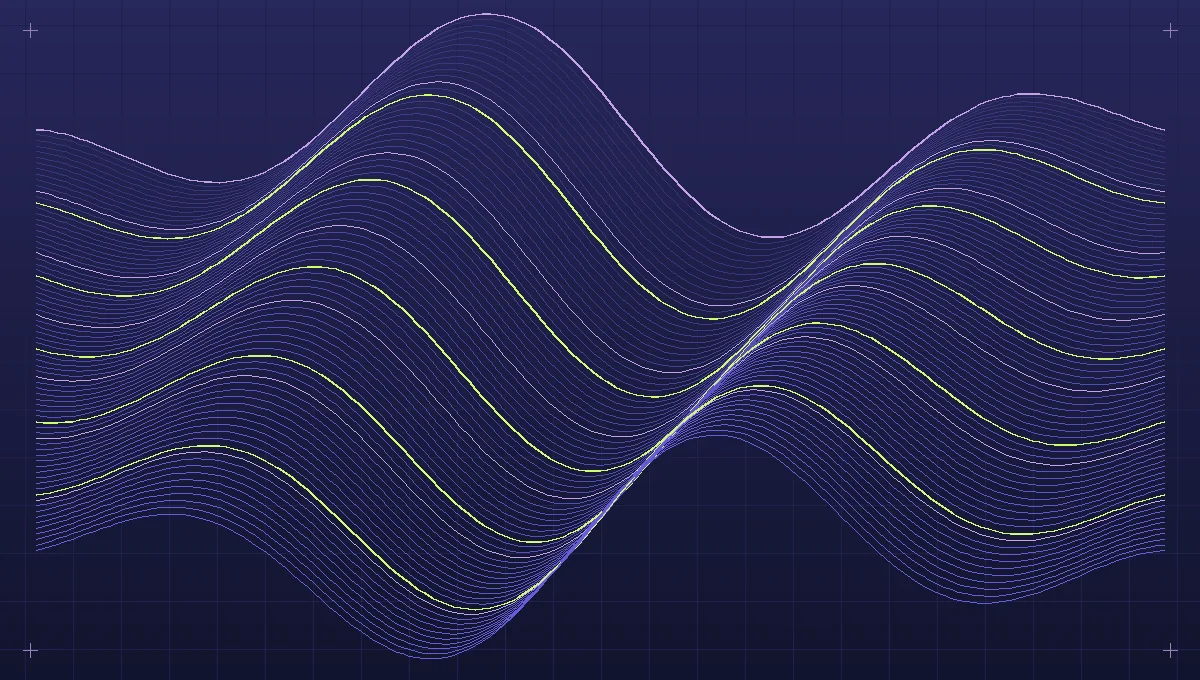
The same cycle can feel quite different at different durations. A rapid change in line curvature might become a vibration, whereas a slow change makes the curves feel like a surface bending gradually. Compare short, intermediate and long loops on the same canvas without changing the geometry. The decision should reflect where the animation will be displayed. A standalone interactive artwork can occupy more of a visitor's attention than a moving illustration beside a technical article. In the latter setting, even an individually attractive animation may interrupt reading.
An experiment with coherent movement
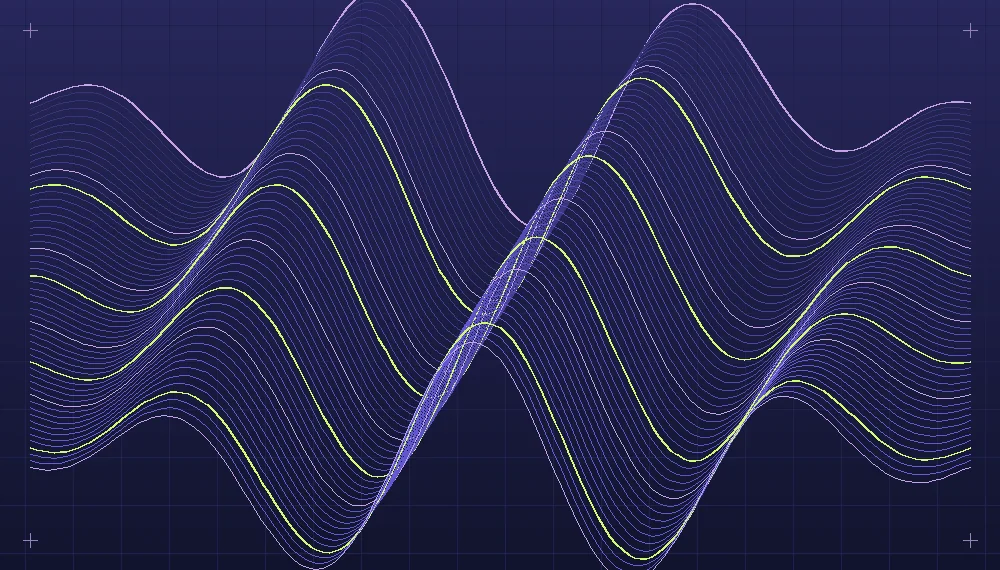
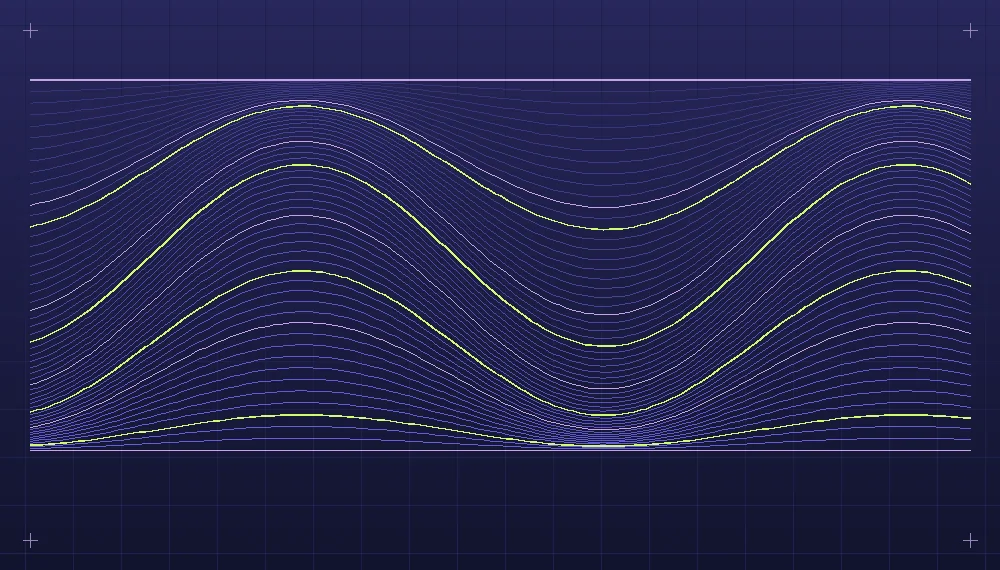
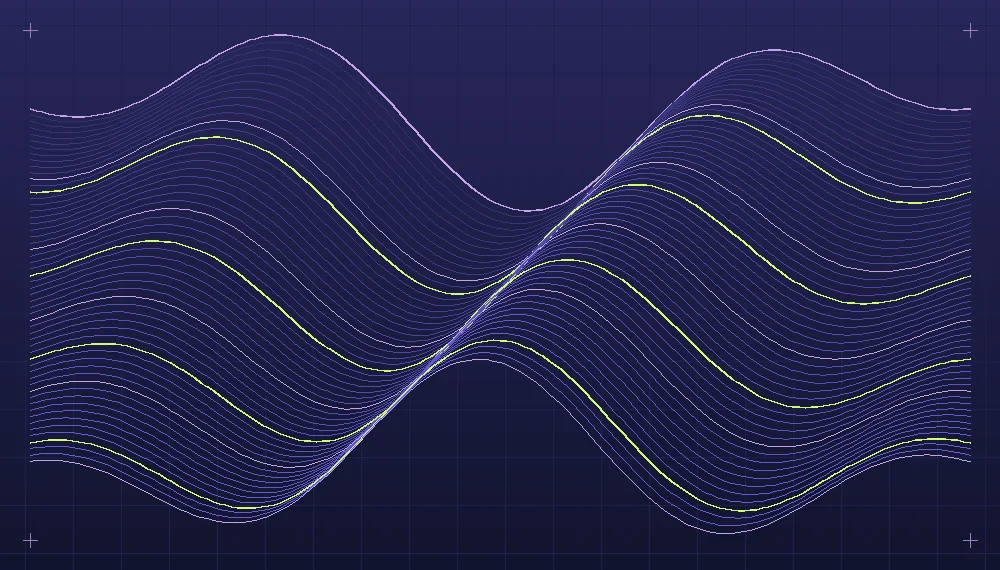
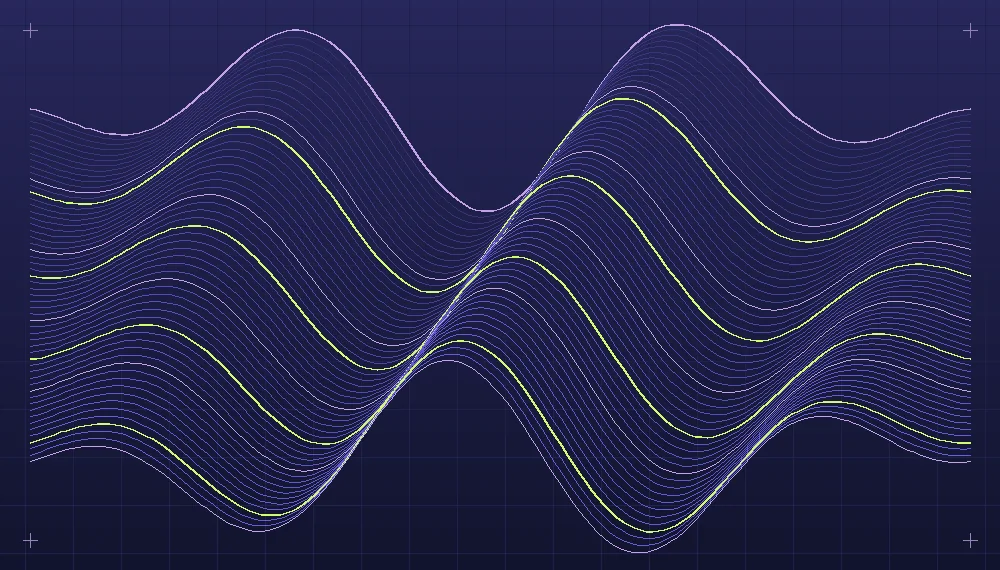
Begin with forty curves spaced vertically across a frame. Their bend amplitude is multiplied by a smooth envelope that falls toward the edges. Draw a set of reference frames using five amplitude values. Inspect them first without animation. At one end of the range the field may be nearly flat; at the other, the lines should still maintain enough separation to reveal their shapes. Restrict the permitted amplitude if the strongest state becomes too crowded. There is little benefit in animating a movement through many states that would be unconvincing as still compositions.
Next, animate the amplitude between the chosen limits with a repeating smooth function. Ensure that the outer boundary and stroke roles stay unchanged. Watch several cycles, noting whether the viewer has time to perceive the most useful states. Increase or reduce cycle duration and try a slight offset between neighboring lines if the system needs more internal movement. Preserve the original version during the comparison. A modest offset that separates the movement into a flowing sequence may be interesting; a different phase for every line could hide the underlying envelope.
Inspect the loop seam by freezing several frames around the transition from the end to the beginning. A matching start and end position is necessary for a seamless loop, but abrupt changes in speed at that point may still be visible. Look at the motion as a whole rather than depending on the numerical equality of the end values. For a one-time transition, consider whether the final state remains a useful artwork after the movement stops.
An animation preview can be captured independently of its web implementation. Save the reference states and, if useful, a short rendered sequence for later comparison. If the interactive version changes, these references help distinguish a change to the artwork from a change in the application that displays it. They also provide useful material for a portfolio page that does not need live motion.
Make animation optional where appropriate
Not every visitor wants continuous animated content. A static frame, reduced-motion version or clear pause control can give the viewer access to the same artistic idea without the normal playback. Choose a representative frame with care rather than capturing an arbitrary instant. It should communicate the composition's essential geometry and color balance. When a sketch has controls, ensure the default view is meaningful even before interaction and the controls remain available while movement is paused. On pages containing written content, keep motion away from the reading area if it interferes with the text.
Finally, test a longer period of viewing. An effect that initially looks impressive may become tiring when repeated indefinitely. Examine whether the artwork's important relationship remains visible after the novelty of motion has worn off. The appealing part of a computational sketch may be its gradual transformation, its alternating moments of order and complexity or the sense of a continuous underlying rule. Movement that expresses those qualities has a clear purpose. An animation does not need to change every available property to reward the viewer's attention.
Explore the implementation area: Artificial art and generative design.